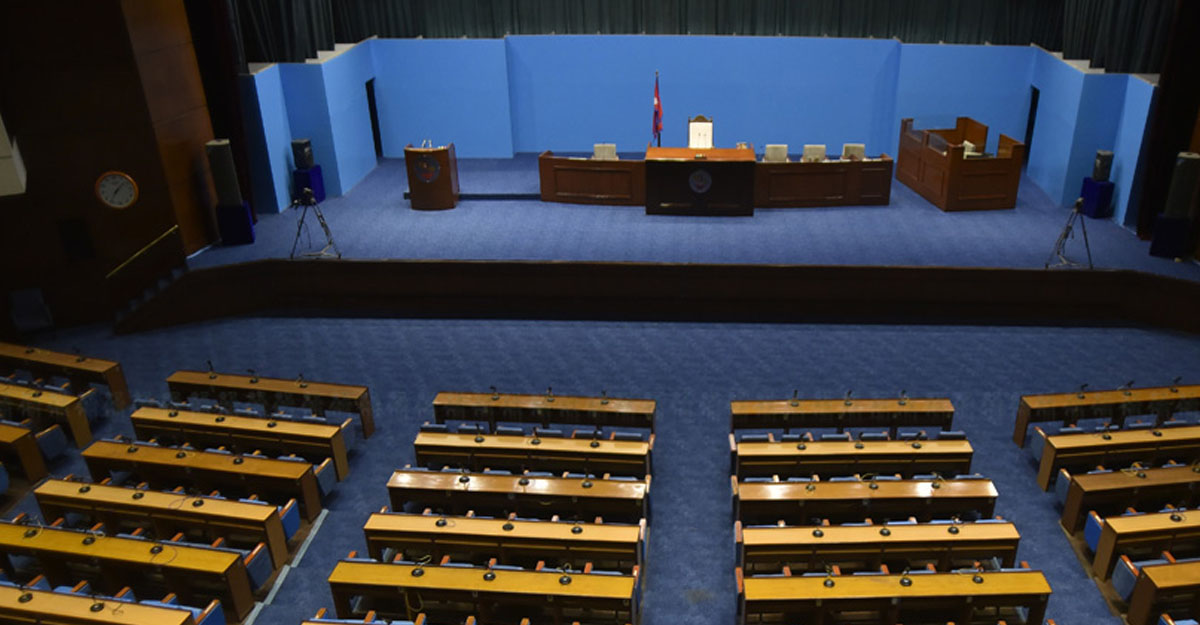
The first meeting of the House of Representatives is expected to convene within a few weeks following the election held on March 5.
The date for the first meeting will be determined by President Ram Chandra Paudel.
According to Article 93 of the Constitution, the first meeting of the House of Representatives must be called within 30 days after the Election Commission submits the election results to the president.
The Election Commission is preparing to submit its election report to the president by March 19. After receiving the results, the president will set the date for the first meeting and formally summon a parliamentary session.
The commission also sends the election results to the Federal Parliament Secretariat. When sending the results, the commission also identifies the oldest member of Parliament.
After receiving the results, the Parliament Secretariat will set the date for the oath-taking ceremony. The secretariat will publish a notice in Gorkhapatra, asking newly-elected lawmakers to attend the ceremony.
Members of Parliament will take the oath before the first meeting, administered by the senior-most member among them.
After taking the oath, lawmakers will be eligible to participate in the first meeting of the House.
The senior-most member will chair the first meeting. During that meeting, the senior member will also propose three other members to preside over the session in their absence.
Election-related ordinances introduced by the interim government will also be tabled during the first House meeting.
These include the Voter List First Amendment Ordinance, the House of Representatives Members Election First Amendment Ordinance, and the Nepal Special Service Second Amendment Ordinance.
According to Article 91 of the Constitution, the process to elect the speaker of the House of Representatives may also begin on the same day, as the Constitution requires that the speaker and deputy speaker be elected within 15 days of the first meeting.
Typically, the first meeting assigns the Parliament’s general secretary the responsibility of publishing the schedule for the speaker’s election.
Parliament generally operates under the House of Representatives Rules, while matters not covered by the rules proceed according to parliamentary conventions.
After the election of the speaker, the deputy speaker will be elected. Because both posts must be filled within 15 days, the process usually begins in the first meeting itself.
There is also a tradition in Parliament of reading out letters sent on different dates by the President’s Office, including notifications about the appointment of the prime minister, formation of the Cabinet, and Cabinet expansion.
The appointment of the prime minister is likely to take place before the first meeting of the House. After receiving the election results, the president will appoint the leader of the party with majority as prime minister.
There is a strong possibility that Balen Shah, the prime ministerial candidate of the Rastriya Swatantra Party, will be appointed prime minister before the first meeting of Parliament. If Shah is appointed, the notification of his appointment will be formally read out during the first meeting.
Until the speaker is elected, the senior-most member will continue to chair House meetings.
During the second meeting, the senior-most member may schedule a program to thank voters of behalf of the parties in Parliament.
However, since the Rastriya Swatantra Party has secured a majority on its own, the speaker is likely to be elected before the second meeting. If the speaker is chosen unanimously, the second meeting could be chaired by the newly-elected speaker.
In Nepal, the speaker has often been elected unanimously in recent years.
Traditionally, during the first meeting of the House of Representatives after an election, party leaders thank voters and extend best wishes to the new government.